

ESP32 Game Development: From a Single Pixel to a 3D Engine

Welcome to a massive original article series on andibond.com! We are embarking on an exciting journey through the world of microcontrollers through the lens of game development.


Why is Game Development on ESP32 Effective?

Programming game logic is the fastest and most fun way to master microcontrollers. While working through this cycle, you will see in practice how the following work:

  • Graphics Output and FPS Optimization;
  • Hardware Interrupt Handling;
  • Memory Management and Dual-Core Architecture;
  • Wireless Protocols: Wi-Fi and Bluetooth.

We have divided our path into 3 Seasons, in each of which the code complexity grows, and the graphical capabilities expand.
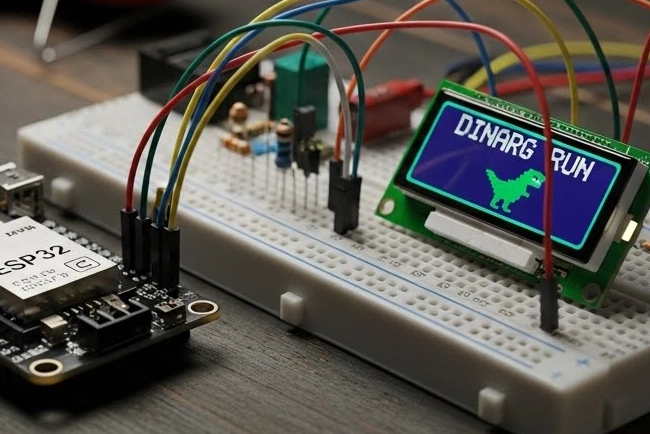
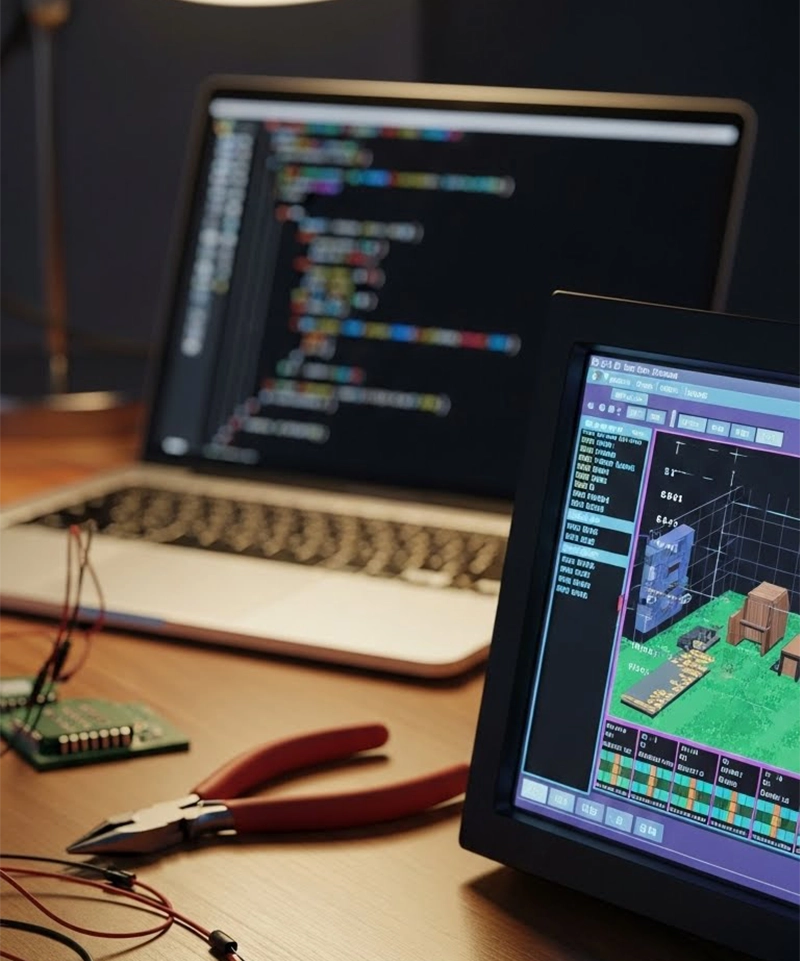
ESP32 game development

AndiBond.com


Season 1: «Pixel Start» (OLED 0.96″)

In this season, we work with classic monochrome displays. Minimum details — maximum logic. Perfect for those picking up an ESP32 for the first time.

  • Dino Run — The legendary Chrome «Easter egg.» Learning to work with bitmaps.
  • Classic Snake — Understanding dynamic arrays and tail mechanics.
  • Flappy Bird — Introducing game gravity and flight physics.
  • 2048 — Working with 4×4 matrices and logical bit shifts.
  • Minesweeper — Basics of recursion and game board generation.
  • Tetris (B&W) — The classic. Learning piece rotation and line-clear checks.

Season 2: «Color & Drive» (TFT 2.4″ – 3.2″)

Moving to color screens with the SPI interface. Here we squeeze every bit of speed out of the ESP32 using the TFT_eSPI library and hardware acceleration.

  • Arkanoid (Breakout) — Ball reflection physics and working with potentiometers.
  • Space Invaders — Handling dozens of sprites without screen flickering.
  • Retro Racing — Pseudo-3D racing in the style of OutRun. Perspective mathematics.
  • Super Mario Clone — A platformer with tile maps and camera scrolling.
  • Raycasting Engine — Creating a 3D maze in the style of Wolfenstein 3D.
  • Pac-Man — Pathfinding algorithms in a labyrinth.
  • Combat Tanks — Shooting projectiles and environment destruction.

Season 3: «Network Mode & Emulation»

Utilizing the ESP32’s «superpowers»: dual cores, Wi-Fi, Bluetooth, and high-speed computation.

  • ESP-NOW Pong — A lag-free duel between two players on different boards.
  • Wi-Fi Quiz — A trivia game where friends join in via their smartphones.
  • GameBoy Emulator — Running real classic ROM files from an SD card.
  • Telegram Quest — A text-based RPG that lives inside your messenger.
  • Bluetooth Joypad — Turning your ESP32 into a wireless PC controller.
  • DOOM (ESP32 Port) — Running the legendary shooter with full sound.
  • VGA Retro Console — Connecting ESP32 to an old monitor and keyboard.

What Will You Need?

To complete this cycle, it is recommended to have the following:

Important Reminder: All presented projects are the result of private engineering research. By using these materials, you take full responsibility for the safety of your equipment and compliance with safety regulations.

  • ESP32 Controller (preferably 2 units for network games).
  • Displays: OLED SSD1306 and TFT ILI9341.
  • Set of buttons, a joystick, and a breadboard.

Your Path to Mastery: From the First Spark to Virtual Worlds

This article series is designed as an interactive roadmap. Each game listed above is not just lines of code, but a vital new skill in your developer’s toolkit. We will start with making a single pixel move and finish by optimizing complex 3D engines and working with network protocols.

Ready to take the first step? Let’s start with something simple yet addictive — bringing the legendary Dino to life!