

Board Capabilities The DEVKIT V1 platform is equipped with a 30-pin interface powered by the ESP-WROOM-32 module. It features a high-performance Tensilica Xtensa LX6 dual-core 32-bit processor at its core.
1. Power Management (VIN, 3.3V, GND). ESP32 DEVKIT V1 Pinout
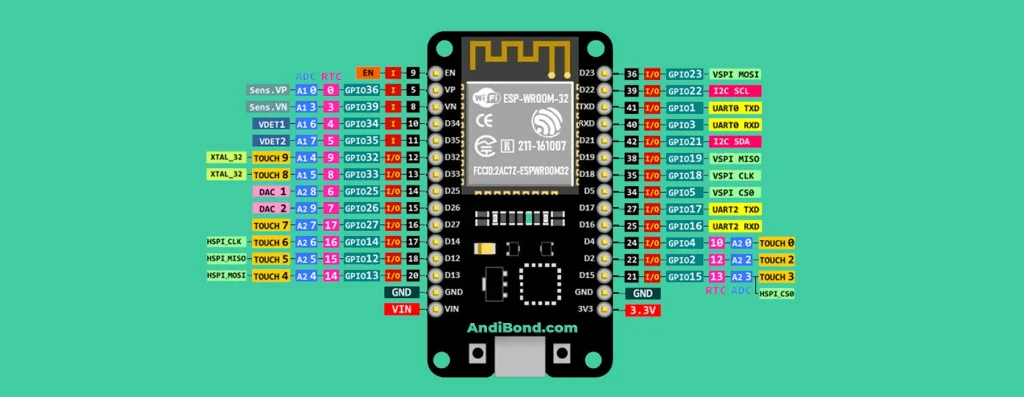
ESP32 DEVKIT V1 Pinout, Voltage Regulation
2. GPIO Functional Overview
Digital I/O and General Purpose Pins Users can freely configure 12 specific GPIOs (16 through 33, excluding some) as either inputs or outputs without hardware conflicts. Note that a subset of pins, specifically GPIO 34, 35, 36, and 39, are dedicated input-only channels and lack internal pull-up resistor support.
3. Boot States and Safety Warnings
Startup State Requirements
4. Analog and Communication Features (ADC, DAC, UART), ESP32 DEVKIT V1 Pinout
Signal Processing & Modulation
5. ESP32 DEVKIT V1 Pinout
| GPIO | Input | Output | Notes |
| 0 | pulled up | OK | outputs PWM signal at boot |
| 1 | TX pin | OK | debug output at boot |
| 2 | OK | OK | connected to on-board LED |
| 3 | OK | RX pin | HIGH at boot |
| 4 | OK | OK | |
| 5 | OK | OK | outputs PWM signal at boot |
| 6 | x | x | connected to the integrated SPI flash |
| 7 | x | x | connected to the integrated SPI flash |
| 8 | x | x | connected to the integrated SPI flash |
| 9 | x | x | connected to the integrated SPI flash |
| 10 | x | x | connected to the integrated SPI flash |
| 11 | x | x | connected to the integrated SPI flash |
| 12 | OK | OK | boot fail if pulled high |
| 13 | OK | OK | |
| 14 | OK | OK | outputs PWM signal at boot |
| 15 | OK | OK | outputs PWM signal at boot |
| 16 | OK | OK | |
| 17 | OK | OK | |
| 18 | OK | OK | |
| 19 | OK | OK | |
| 21 | OK | OK | |
| 22 | OK | OK | |
| 23 | OK | OK | |
| 25 | OK | OK | |
| 26 | OK | OK | |
| 27 | OK | OK | |
| 32 | OK | OK | |
| 33 | OK | OK | |
| 34 | OK | input only | |
| 35 | OK | input only | |
| 36 | OK | input only | |
| 39 | OK | input only |
Support the AndiBond project
Creating high-quality guides, finding working solutions, and debugging code takes a lot of time. All my projects remain open-source and free, so that everyone can enter the world of electronics with the lowest possible barrier to entry.
If this tutorial saved you time or helped you launch your first game on the ESP32, you can support the blog’s development. Your support helps me purchase new sensors, displays, and controllers for future reviews and projects.
Every donation is fuel for new articles and videos. Thank you for being with me!