

1. Module Overview and System Architecture
The ESP32-PICO-V3-ZERO Pinout represents the specialized interface of an Alexa Connect Kit (ACK) module, designed by Espressif to simplify the integration of voice-controlled smart home features. This module is built around the ESP32 series of System-in-Package (SiP) technology, specifically utilizing the Xtensa dual-core 32-bit LX6 microprocessor. By integrating the ESP32-V3 chip, a 40 MHz crystal oscillator, 4 MB of SPI flash, filter capacitors, and RF matching links into a single 16 x 23 x 2.3 mm package, the module provides a «zero-code» cloud connectivity solution for developers.
A common point of confusion in hardware design is the distinction between the SoC series and the specific chip name. While the series refers to the broad «ESP32» family, the chip name within this module—ESP32-PICO-V3—denotes a specific SiP variant. Unlike standard WROOM modules where flash is external to the silicon package, «PICO» variants integrate the flash memory directly into the SiP. This integration means that the internal flash pins are not part of the external ESP32-PICO-V3-ZERO Pinout, freeing up board space and reducing RF interference. The chip name often reflects these internal enhancements, such as integrated PSRAM or specific flash capacities, which are essential for the ACK firmware to operate without external memory overhead.
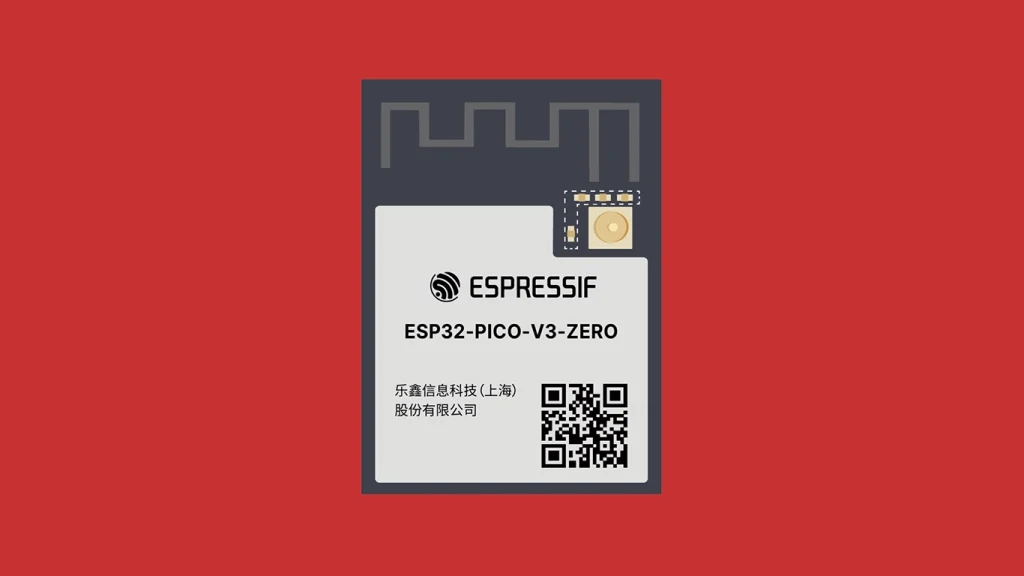
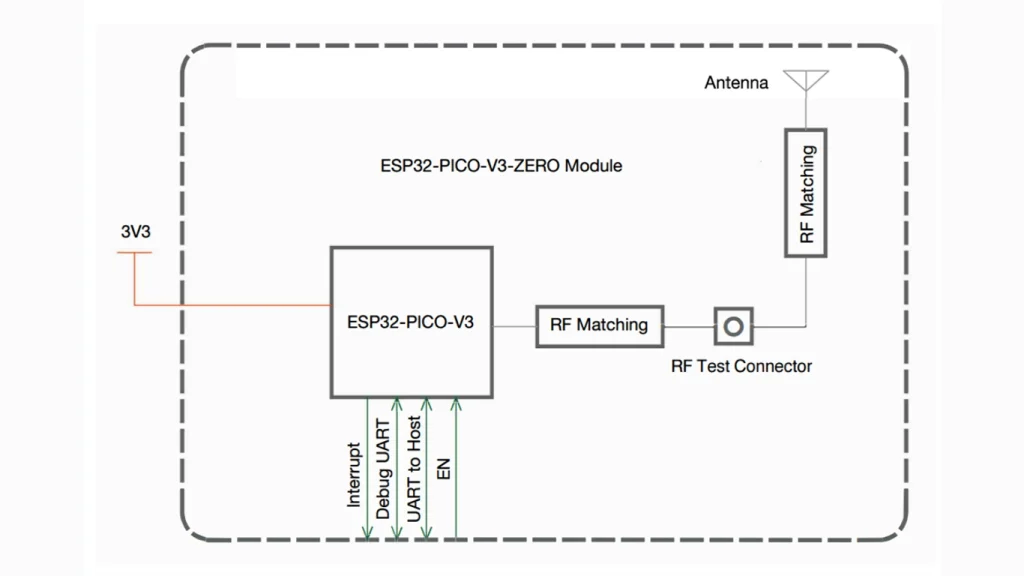
The module’s architecture is optimized for low-power 2.4 GHz Wi-Fi and dual-mode Bluetooth (v4.2 BR/EDR and Bluetooth LE). It features an on-board PCB antenna with an RF test connector, though the connector is intended strictly for factory testing and not for external antenna attachment. Because the ESP32-PICO-V3-ZERO Pinout is tailored for ACK, it emphasizes stability and ease of manufacture, allowing hardware architects to focus on the end-product features rather than complex RF layout and cloud security protocols.
2. ESP32-PICO-V3-ZERO Pinout Power Options and LDO Logic
Powering the module requires a stable DC supply between 3.0 V and 3.6 V, with a recommended operating voltage of 3.3 V. The ESP32-PICO-V3-ZERO Pinout provides multiple VDD33 and GND pins to ensure a low-impedance path for current, which is critical during high-power Wi-Fi transmission bursts that can exceed 500 mA. Proper decoupling and wide PCB traces for these power paths are essential to prevent brownout resets.
The role of the LDO (Low-Dropout Regulator) is a vital consideration for hardware engineers. An LDO is a linear voltage regulator that maintains a steady output voltage even when the input voltage is only slightly higher. In many designs, an external LDO is used to step down a 5V USB supply to the 3.3V required by the ESP32-PICO-V3-ZERO Pinout. The primary advantage of an LDO over a switching regulator is its extremely low output noise, which is vital for the sensitive analog circuitry within the Wi-Fi radio. However, LDOs dissipate the voltage difference as heat. Designers must calculate the thermal resistance of their LDO package and ensure adequate copper pours on the PCB. If the LDO overheats, it may enter thermal shutdown, causing the module to lose power and drop its Alexa connection.
Furthermore, the ESP32-PICO-V3-ZERO Pinout includes internal LDO management for flash voltage. The strapping pin MTDI (GPIO12) determines the voltage level of the internal VDD_SDIO rail at reset. By default, this is set to 3.3V (MTDI low), but it can be configured to 1.8V if the internal components require it. This hardware-level logic ensures that the integrated flash memory receives the correct operating voltage before the processor even begins executing the bootloader.
WARNING: NEVER apply power to the VDD33 pins while simultaneously providing power through an unshielded USB-to-Serial bridge. This can create a ground loop or back-feed voltage into your computer’s USB port, potentially damaging both the module and the host PC. Always ensure a common ground and use protection diodes if multiple power paths are required.
3. Advanced Peripherals: ADC Architecture and UART Communication
The ESP32-PICO-V3-ZERO Pinout grants access to a high-performance ADC (Analog-to-Digital Converter). The ESP32 utilizes a Successive Approximation Register (SAR) ADC architecture. This process works by comparing the input analog voltage against a series of reference voltages in a binary search pattern to determine each bit of the digital output. With up to 12-bit resolution, the ADC can distinguish 4,096 distinct voltage levels. This precision is influenced by the «attenuation» setting and the stability of the reference voltage. Engineers should note that the ESP32 ADC is non-linear at the edges of its range (near 0V and near the maximum VDD), so software calibration is often required for high-accuracy sensor measurements.
Serial communication is the backbone of development, and the UART (Universal Asynchronous Receiver-Transmitter) serves as the primary bridge between the SoC and external devices. The ESP32-PICO-V3-ZERO Pinout features two primary UART interfaces: UART0 (for debugging) and UART1 (for the host interface). UART is an asynchronous protocol, meaning it does not use a shared clock signal. Instead, both the module and the host must be synchronized to the same baud rate (e.g., 115,200 or 921,600 bps). The logic levels are strictly 3.3V; connecting the UART pins to a 5V system without level shifters will likely destroy the internal I/O buffers. The UART interface also supports hardware flow control (RTS/CTS), which is essential for the ACK protocol to prevent buffer overflows during large data transfers between the module and the host MCU.
4. ESP32-PICO-V3-ZERO Pinout Comprehensive Mapping
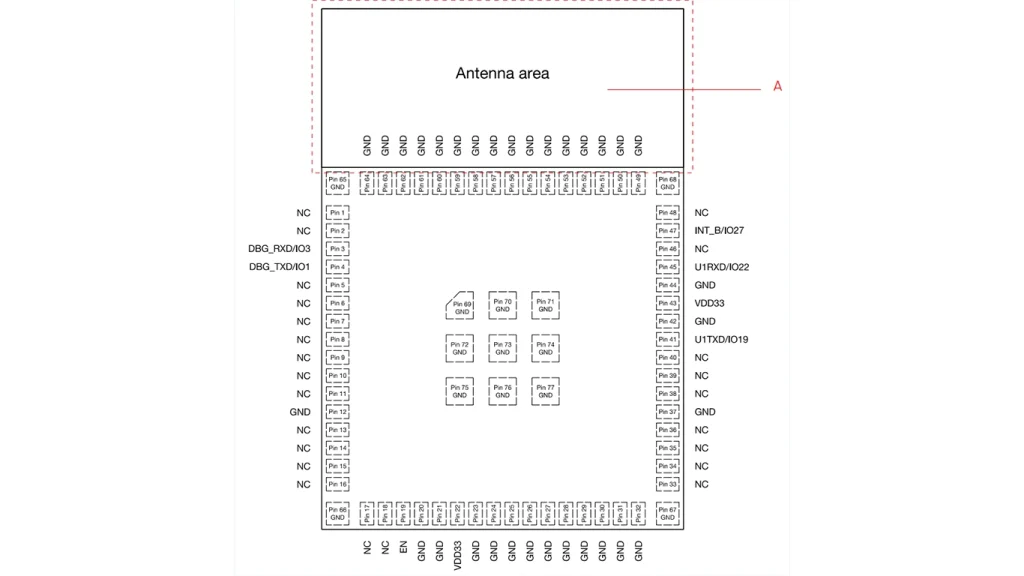
Below is the complete physical pin mapping for the module. Every pad, including those marked as No-Connect (NC) or Ground (GND), must be accounted for in the PCB footprint to ensure mechanical stability and electrical integrity.
| Pin # | Name | Type | Function |
|---|---|---|---|
| 1 | NC | NA | Do not connect. Leave floating. |
| 2 | NC | NA | Do not connect. Leave floating. |
| 3 | DBG_RXD/IO3 | I | GPIO3, Debugging UART RX |
| 4 | DBG_TXD/IO1 | O | GPIO1, Debugging UART TX |
| 5 | NC | NA | Do not connect. Leave floating. |
| 6 | NC | NA | Do not connect. Leave floating. |
| 7 | NC | NA | Do not connect. Leave floating. |
| 8 | NC | NA | Do not connect. Leave floating. |
| 9 | NC | NA | Do not connect. Leave floating. |
| 10 | NC | NA | Do not connect. Leave floating. |
| 11 | NC | NA | Do not connect. Leave floating. |
| 12 | GND | P | Ground |
| 13 | NC | NA | Do not connect. Leave floating. |
| 14 | NC | NA | Do not connect. Leave floating. |
| 15 | NC | NA | Do not connect. Leave floating. |
| 16 | NC | NA | Do not connect. Leave floating. |
| 17 | NC | NA | Do not connect. Leave floating. |
| 18 | NC | NA | Do not connect. Leave floating. |
| 19 | EN | I | High: On; enables the module. Low: Off. Do not leave floating. |
| 20 | GND | P | Ground |
| 21 | GND | P | Ground |
| 22 | VDD33 | P | Power supply (3.0 V ~ 3.6 V) |
| 23 | GND | P | Ground |
| 24 | GND | P | Ground |
| 25 | GND | P | Ground |
| 26 | GND | P | Ground |
| 27 | GND | P | Ground |
| 28 | GND | P | Ground |
| 29 | GND | P | Ground |
| 30 | GND | P | Ground |
| 31 | GND | P | Ground |
| 32 | GND | P | Ground |
| 33 | NC | NA | Do not connect. Leave floating. |
| 34 | NC | NA | Do not connect. Leave floating. |
| 35 | NC | NA | Do not connect. Leave floating. |
| 36 | NC | NA | Do not connect. Leave floating. |
| 37 | GND | P | Ground |
| 38 | NC | NA | Do not connect. Leave floating. |
| 39 | NC | NA | Do not connect. Leave floating. |
| 40 | NC | NA | Do not connect. Leave floating. |
| 41 | U1TXD/IO19 | O | UART TX, connected to host RX, GPIO19 |
| 42 | GND | P | Ground |
| 43 | VDD33 | P | Power supply (3.0 V ~ 3.6 V) |
| 44 | GND | P | Ground |
| 45 | U1RXD/IO22 | I | UART RX, connected to host TX, GPIO22 |
| 46 | NC | NA | Do not connect. Leave floating. |
| 47 | INT_B/IO27 | O | Host interrupt, connected to host GPIO, GPIO27 |
| 48 | NC | NA | Do not connect. Leave floating. |
| 49-77 | GND | P | Thermal and Signal Ground pads |
5. Boot Logic and Strapping Pins Sampling
The boot behavior of the ESP32-PICO-V3-ZERO Pinout is determined by Strapping Pins. These specific GPIOs are sampled by the hardware at the moment the reset signal (CHIP_PU/EN) is released. The logic levels detected on these pins at that precise microsecond determine if the chip boots from its internal flash or enters a download mode for new firmware. The primary strapping pins include GPIO0 and GPIO2.
By default, these pins have internal weak pull-up or pull-down resistors. For example, GPIO0 has an internal pull-up, meaning its default state is High (Binary 1), which leads the chip to «SPI Boot Mode» (normal operation). If a developer pulls GPIO0 Low during reset, the chip enters «Joint Download Boot Mode,» allowing firmware to be uploaded over UART. Because these pins are repurposed as regular I/O after the boot sequence is complete, designers must ensure that any external circuitry connected to them does not accidentally pull the voltage to the wrong level during power-up, which would cause the module to hang or enter the wrong mode.
6. Programming Guide: Firmware Download Mode
To update the ACK firmware via the ESP32-PICO-V3-ZERO Pinout, you must manually or programmatically trigger the download sequence. This involves a specific timing coordination between the EN and GPIO0 pins. In a typical development setup, this is handled by a «reset circuit» consisting of two NPN transistors, but it can also be done with tactile buttons.
The sequence is as follows:
- Hold the GPIO0 (Strapping Pin) to Ground.
- Pull the EN pin to Ground to reset the chip.
- Release the EN pin while continuing to hold GPIO0 Low.
- Wait for the «waiting for download» message on the Debug UART at 115,200 baud.
- Release GPIO0.
Once in this state, the internal ROM bootloader takes control, allowing the host PC to stream binary data into the 4 MB flash. After the upload is complete, a simple pulse on the EN pin (with GPIO0 floating/High) will launch the new application code.
7. Conclusion
Mastering the ESP32-PICO-V3-ZERO Pinout is the first step in successful Alexa Connect Kit integration. By understanding the electrical nuances of the LDO heat dissipation, the SAR architecture of the ADC, and the critical timing of the strapping pins, engineers can build robust, production-ready hardware. This module’s SiP design significantly reduces the complexity usually associated with Wi-Fi development, provided that the power delivery and boot configurations are correctly implemented according to the datasheet specifications.
8. References & Legal Notice
This technical manual is developed based on the official documentation provided by Espressif Systems. We highly recommend referring to the primary source for the most recent updates regarding hardware revisions and detailed specifications.
Disclaimer: ESP32 and ESP32-S2 are registered trademarks of Espressif Systems (Shanghai) Co., Ltd. This guide is an independent technical review and is not an official publication of Espressif Systems.