

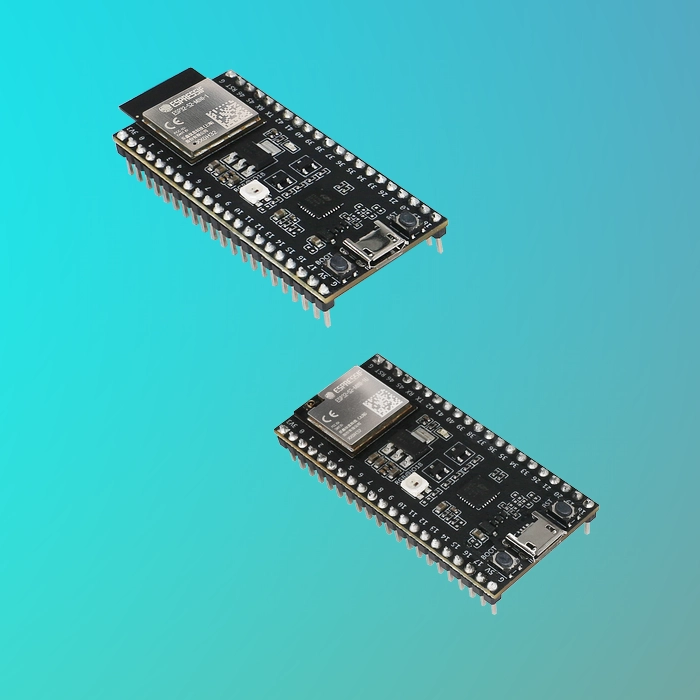
The ESP32-S2-DevKitM-1 is an entry-level development board from Espressif, powered by the ESP32-S2-MINI-1 series modules (or ESP32-S2-MINI-1U for external antenna). This board is engineered to provide a seamless transition from concept to prototype, offering high performance in a compact form factor.
1. Hardware Overview & Features
The board is built around the ESP32-S2FH4 SoC, which features a single-core 32-bit LX7 microprocessor running at up to 240 MHz.
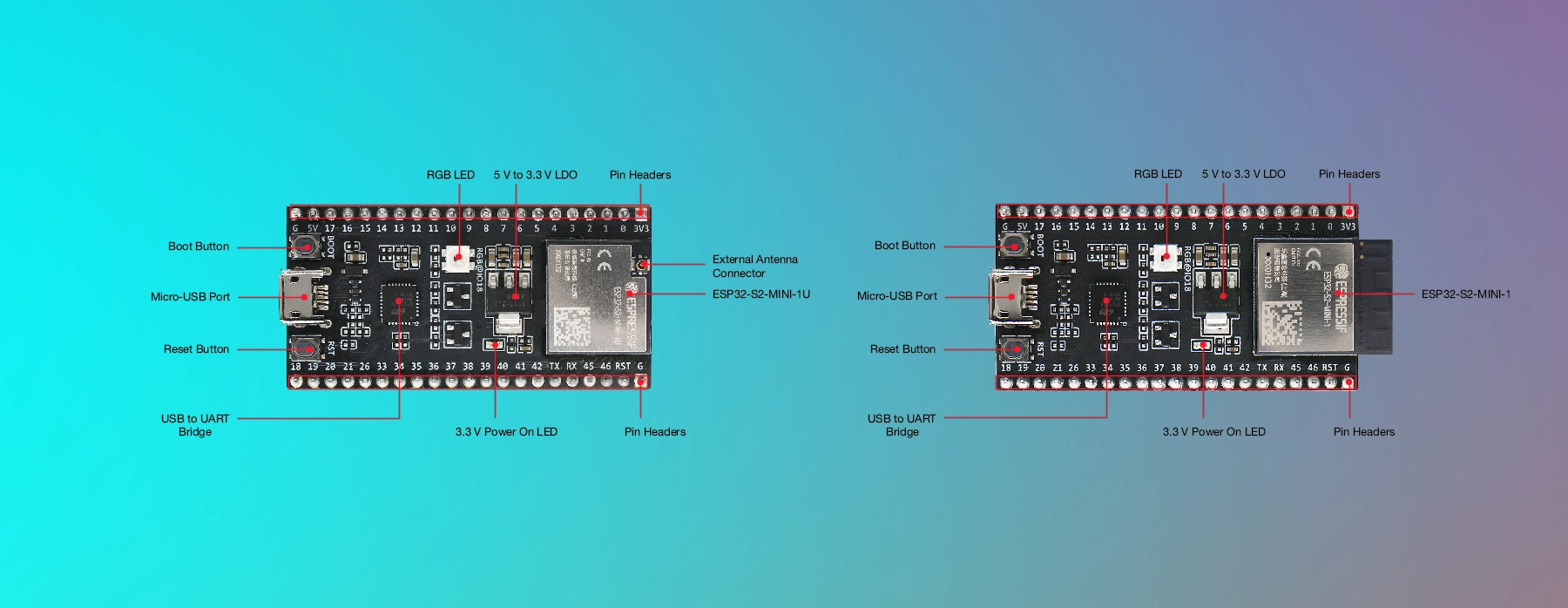
Key Components:
2. Power Supply Options
The board supports three mutually exclusive power methods. Warning: Do not use more than one power source simultaneously.
3. Detailed ESP32-S2-DevKitM-1 Pinout
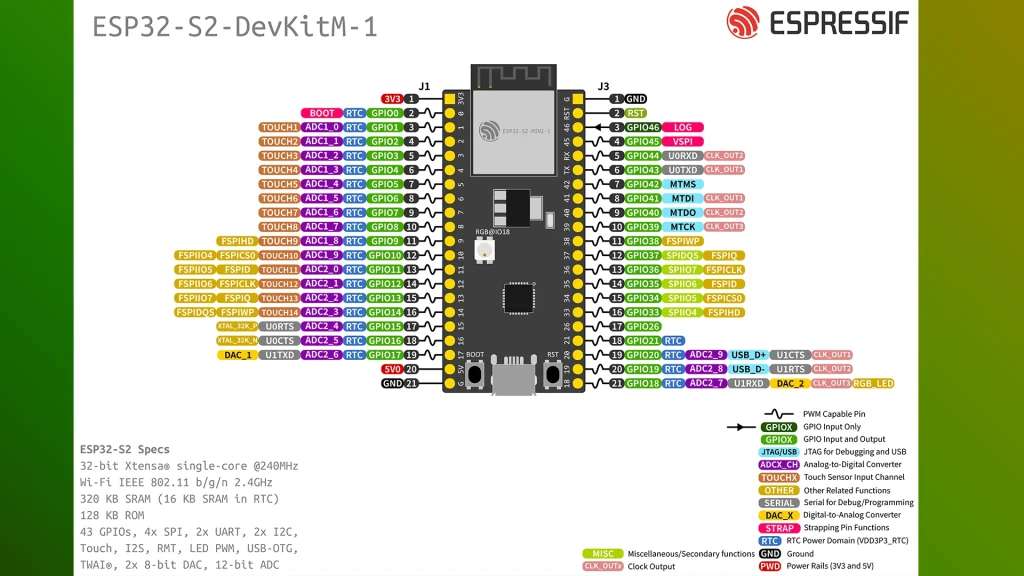
The development board features two 22-pin headers. Below is the exhaustive mapping of every pin and its multiplexed functions.
Header J1 (Left Side)
| Pin | Name | Type | Full Functional Description |
| 1 | 3V3 | P | 3.3V power supply (Output or Input). |
| 2 | 0 | I/O | GPIO0, RTC_GPIO0, Boot button. |
| 3 | 1 | I/O | GPIO1, ADC1_CH0, TOUCH1, RTC_GPIO1. |
| 4 | 2 | I/O | GPIO2, ADC1_CH1, TOUCH2, RTC_GPIO2. |
| 5 | 3 | I/O | GPIO3, ADC1_CH2, TOUCH3, RTC_GPIO3. |
| 6 | 4 | I/O | GPIO4, ADC1_CH3, TOUCH4, RTC_GPIO4. |
| 7 | 5 | I/O | GPIO5, ADC1_CH4, TOUCH5, RTC_GPIO5. |
| 8 | 6 | I/O | GPIO6, ADC1_CH5, TOUCH6, RTC_GPIO6. |
| 9 | 7 | I/O | GPIO7, ADC1_CH6, TOUCH7, RTC_GPIO7. |
| 10 | 8 | I/O | GPIO8, ADC1_CH7, TOUCH8, RTC_GPIO8. |
| 11 | 9 | I/O | GPIO9, ADC1_CH8, TOUCH9, FSPIHD. |
| 12 | 10 | I/O | GPIO10, ADC1_CH9, TOUCH10, FSPICS0, FSPIIO4. |
| 13 | 11 | I/O | GPIO11, ADC2_CH0, TOUCH11, FSPID, FSPIIO5. |
| 14 | 12 | I/O | GPIO12, ADC2_CH1, TOUCH12, FSPICLK, FSPIIO6. |
| 15 | 13 | I/O | GPIO13, ADC2_CH2, TOUCH13, FSPIQ, FSPIIO7. |
| 16 | 14 | I/O | GPIO14, ADC2_CH3, TOUCH14, FSPIWP, FSPIDQS. |
| 17 | 15 | I/O | GPIO15, ADC2_CH4, XTAL_32K_P, RTC_GPIO15. |
| 18 | 16 | I/O | GPIO16, ADC2_CH5, XTAL_32K_N, RTC_GPIO16. |
| 19 | 17 | I/O | GPIO17, ADC2_CH6, DAC_1, RTC_GPIO17. |
| 20 | 18 | I/O | GPIO18, ADC2_CH7, DAC_2, RGB LED Control. |
| 21 | 5V | P | 5V power supply (Output or Input). |
| 22 | GND | G | Ground connection. |
Header J3 (Right Side)
| Pin | Name | Type | Full Functional Description |
| 1 | GND | G | Ground connection. |
| 2 | TX | I/O | GPIO43, U0TXD (UART0 Transmit). |
| 3 | RX | I/O | GPIO44, U0RXD (UART0 Receive). |
| 4 | 21 | I/O | GPIO21, RTC_GPIO21. |
| 5 | 20 | I/O | GPIO20, USB_D+, ADC2_CH9, RTC_GPIO20. |
| 6 | 19 | I/O | GPIO19, USB_D-, ADC2_CH8, RTC_GPIO19. |
| 7 | 46 | I | GPIO46, (Input Only pin). |
| 8 | 45 | I/O | GPIO45. |
| 9 | 42 | I/O | GPIO42, MTMS (JTAG). |
| 10 | 41 | I/O | GPIO41, MTDI (JTAG). |
| 11 | 40 | I/O | GPIO40, MTDO (JTAG). |
| 12 | 39 | I/O | GPIO39, MTCK (JTAG). |
| 13 | 38 | I/O | GPIO38, FSPIWP. |
| 14 | 37 | I/O | GPIO37, FSPIQ. |
| 15 | 36 | I/O | GPIO36, FSPICLK. |
| 16 | 35 | I/O | GPIO35, FSPID. |
| 17 | 34 | I/O | GPIO34, FSPICS0. |
| 18 | 33 | I/O | GPIO33, FSPIHD. |
| 19 | 26 | I/O | GPIO26, RTC_GPIO26. |
| 20 | GND | G | Ground connection. |
| 21 | GND | G | Ground connection. |
| 22 | NC | — | Not Connected. |
4. Advanced Peripheral Features
Understanding the ESP32-S2-DevKitM-1 Pinout involves knowing the specialized capabilities of certain pins:
6. References & Legal Notice
This technical manual is developed based on the official documentation provided by Espressif Systems. We highly recommend referring to the primary source for the most recent updates regarding hardware revisions and detailed specifications.
Disclaimer: ESP32 and ESP32-S2 are registered trademarks of Espressif Systems (Shanghai) Co., Ltd. This guide is an independent technical review and is not an official publication of Espressif Systems.