

The ESP8266EX serves as a cornerstone in the Internet of Things (IoT) landscape, providing a highly integrated Wi-Fi System-on-Chip (SoC) designed for power efficiency and compact performance
. This 32-bit RISC processor, the Tensilica L106, can reach clock speeds of up to 160 MHz while maintaining an exceptionally low power profile
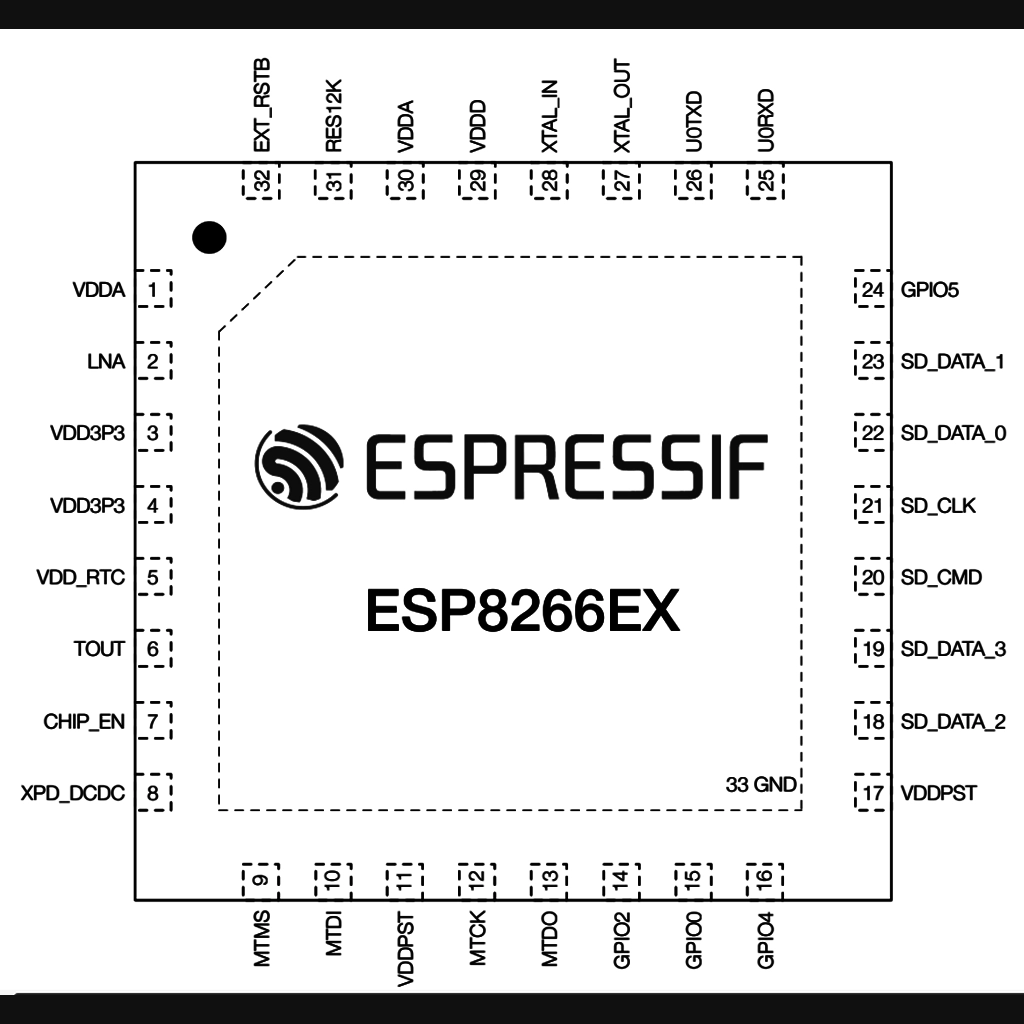
. In the hardware ecosystem, understanding the ESP8266EX Pinout is critical for developers transitioning from high-level software to low-level electrical logic.
SoC Series vs. Specific Chip Names
In the Espressif ecosystem, it is vital to distinguish between a SoC series and a specific chip or module name. While «ESP8266» refers to the broad series of Wi-Fi-enabled chips, the ESP8266EX is the specific 32-pin QFN silicon implementation
. Often, names like «ESP-12F» or «WROOM» refer to modules that integrate this core chip alongside a flash memory chip, an antenna, and a voltage regulator. Because the ESP8266EX does not have internal programmable ROM, it must boot from an external SPI flash, which is often integrated into these named modules to provide a ready-to-use hardware package.
1. Power Options and Electrical Architecture
Providing clean, stable power is the first requirement for any hardware design using the ESP8266EX. The chip operates on a voltage range of 2.5 V to 3.6 V.
Warning: Never power the ESP8266EX through the USB port and an external 3.3V source simultaneously. Doing so can cause back-feeding and may permanently damage the SoC or the host computer’s USB port.
2. The ESP8266EX Pinout: Detailed Pin Definitions
A thorough understanding of the ESP8266EX Pinout allows for precise interfacing with sensors and peripherals. The 32-pin QFN package distributes power, ground, and I/O pins strategically to minimize interference.
| Pin | Name | Type | Function |
| 1 | VDDA | P | Analog Power 2.5 V ~ 3.6 V |
| 2 | LNA | I/O | RF antenna interface Chip output impedance = 39 + j6 Ω. It is suggested to retain the π-type matching network to match the antenna. |
| 3 | VDD3P3 | P | Amplifier Power 2.5 V ~ 3.6 V |
| 4 | VDD3P3 | P | Amplifier Power 2.5 V ~ 3.6 V |
| 5 | VDD_RTC | P | NC (1.1 V) |
| 6 | TOUT | I | ADC pin. It can be used to test the power-supply voltage of VDD3P3 (Pin3 and Pin4) and the input power voltage of TOUT (Pin 6). However, these two functions cannot be used simultaneously. |
| 7 | CHIP_EN | I | Chip Enable High: On, chip works properly Low: Off, small current consumed Low: Off, small current consumed |
| 8 | XPD_DCDC | I/O | Deep-sleep wakeup (need to be connected to EXT_RSTB); GPIO16 |
| 9 | MTMS | I/O | GPIO 14; HSPI_CLK |
| 10 | MTDI | I/O | GPIO 12; HSPI_MISO |
| 11 | VDDPST | P | Digital/IO Power Supply (1.8 V ~ 3.6 V) |
| 12 | MTCK | I/O | GPIO 13; HSPI_MOSI; UART0_CTS |
| 13 | MTDO | I/O | GPIO 15; HSPI_CS; UART0_RTS |
| 14 | GPIO2 | I/O | UART TX during flash programming; GPIO2 |
| 15 | GPIO0 | I/O | GPIO0; SPI_CS2 |
| 16 | GPIO4 | I/O | GPIO4 |
| 17 | VDDPST | P | Digital/IO Power Supply (1.8 V ~ 3.6 V) |
| 18 | SDIO_DATA_2 | I/O | Connect to SD_D2 (Series R: 20 Q); SPIHD; HSPIHD; |
| 19 | SDIO_DATA_3 | I/O | Gonnect to SD_D3 (Series R: 200 Q); SPIWP; HSPIWP; GPIO10 |
| 20 | SDIO_CMD | I/O | Connect to SD_CMD (Series R: 200 Q); SPI_CS0; GPIO11 |
| 21 | SDIO_CLK | I/O | Connect to SD_CLK (Series R: 200 Q); SPI_CLK; GPIO6 |
| 22 | SDIO_DATA_0 | I/O | Connect to SD_D0 (Series R: 200 Q); SPI_MISO; GPIO7 |
| 23 | SDIO_DATA_1 | I/O | Connect to SD_D1 (Series R: 200 Q); SPI_MOSI; GPIO8 |
| 24 | GPIO5 | I/O | GPIO5 |
| 25 | U0RXD | I/O | UART Rx during flash programming; GPIO3 |
| 26 | U0TXD | I/O | UART TX during flash programming; GPIO1; SPI_CS1 |
| 27 | XTAL_OUT | I/O | Connect to crystal oscillator output, can be used to provide BT clock input |
| 28 | XTAL_IN | I/O | Connect to crystal oscillator input |
| 29 | VDDD | P | Analog Power 2.5 V ~ 3.6 V |
| 30 | VDDA | P | Analog Power 2.5 V ~ 3.6 V |
| 31 | RES12K | I | Serial connection with a 12 kQ resistor and connect to the ground |
| 32 | EXT_RSTB | I | External reset signal (Low voltage level: active) |
3. Technical Depth: ADC, UART, and Strapping Pins
ADC (Analog-to-Digital Converter)
The ESP8266EX features a 10-bit precision Successive Approximation Register (SAR) ADC. The process of converting analog sensor voltages into digital bits involves sampling the voltage at the TOUT pin (Pin 6) and comparing it against a reference. This allows the SoC to «read» the real world, such as the output from a temperature sensor or a light-dependent resistor. Note that this pin can either measure the internal supply voltage or an external voltage, but not both at the same time.
UART (Universal Asynchronous Receiver Transmitter)
The UART serves as a serial interface bridge for PC-to-SoC communication
. The ESP8266EX has two UART interfaces: UART0 for general communication and programming, and UART1, which is often dedicated to printing system logs. During the development phase, the UART is the primary method for «flashing» or uploading code from a computer to the SoC.
Strapping Pins and Logic
Strapping pins are specific GPIOs (GPIO0, GPIO2, and MTDO/GPIO15) that are sampled at the exact moment of boot or reset to determine the chip’s operating mode.
4. Programming Section: Firmware Download Mode
To upload code, you must manually or automatically trigger the «Firmware Download Mode» using the ESP8266EX Pinout strapping configuration.
Once the reset is released, the L106 processor samples these pins and enters Download Mode, allowing the computer to send the binary files over the UART0 RX/TX lines.
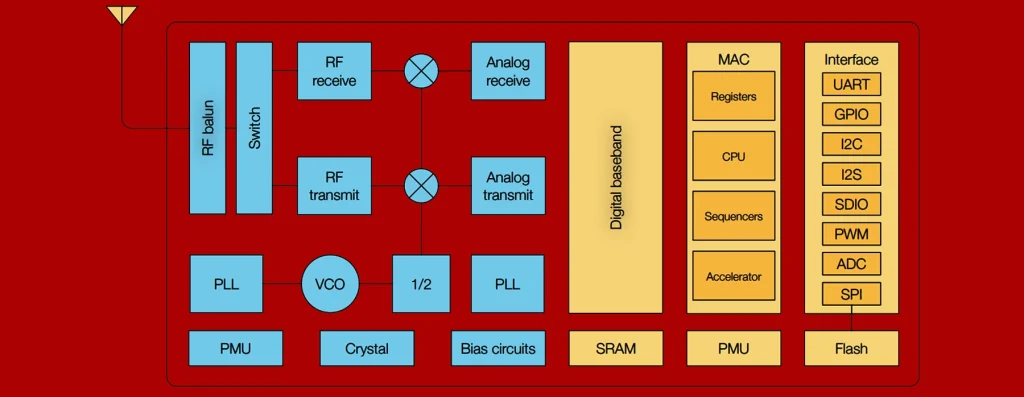
The internal architecture shown in the block diagram highlights how the digital baseband, MAC, and CPU interact with the peripheral interfaces like SPI, I2C, and UART to create a unified IoT solution. By mastering the ESP8266EX Pinout, hardware architects can leverage these internal blocks for complex automation and sensor networking.
5. References & Legal Notice
This technical manual is developed based on the official documentation provided by Espressif Systems. We highly recommend referring to the primary source for the most recent updates regarding hardware revisions and detailed specifications.
Disclaimer: ESP32 and ESP32-S2 are registered trademarks of Espressif Systems (Shanghai) Co., Ltd. This guide is an independent technical review and is not an official publication of Espressif Systems.