

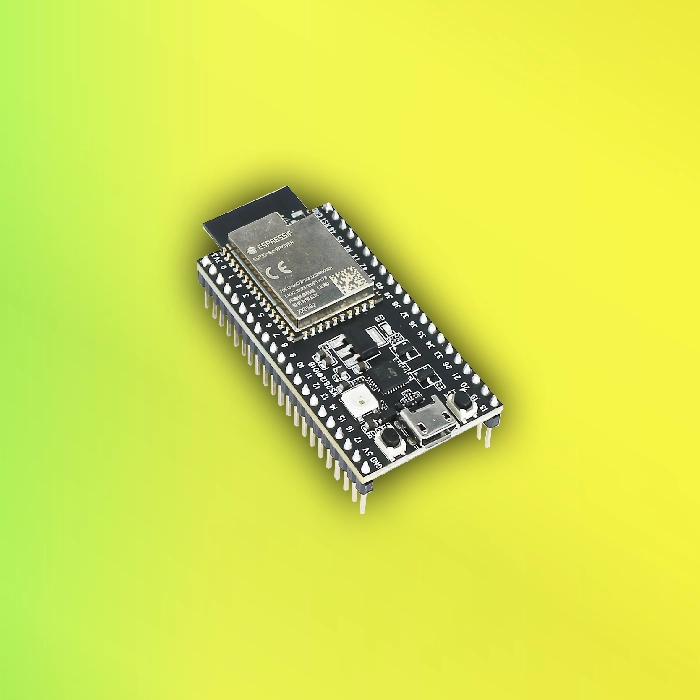
The ESP32-S2-Saola-1 is a small-sized development board produced by Espressif, based on the powerful ESP32-S2 series of chips. Designed for versatility, most of its I/O pins are broken out to headers on both sides, allowing developers to easily interface with peripherals using jumper wires or by mounting the board directly onto a breadboard.
1. Overview
The ESP32-S2-Saola-1 supports a variety of modules to cover diverse user needs:
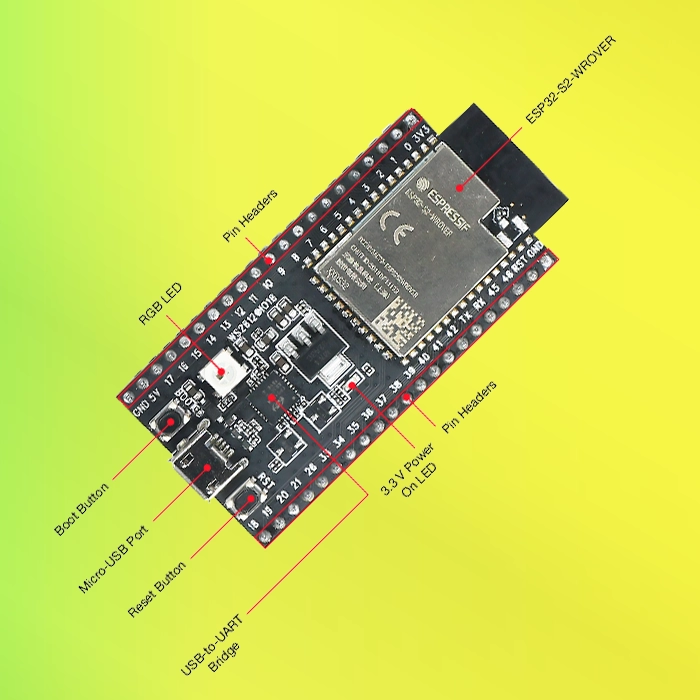
2. Key Components
3. Power Supply Options
The board offers three mutually exclusive ways to provide power:
4 ESP32-S2-Saola-1 Pinout Details
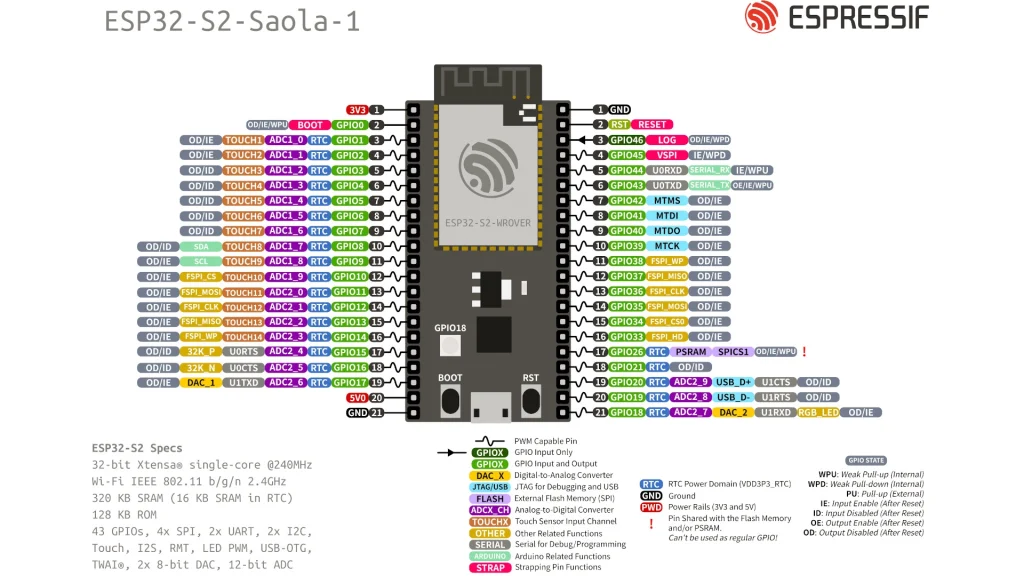
The board features two main headers, J2 and J3. All available GPIO pins (except the internal SPI bus for flash/PSRAM) are broken out.
Header J2 (Left Side)
| No. | Name | Type | Function |
| 1 | 3V3 | P | 3.3 V Power Supply |
| 2 | IO0 | I/O | GPIO0, Boot Button |
| 3 | IO1 | I/O | GPIO1, ADC1_CH0, TOUCH_CH1 |
| 4 | IO2 | I/O | GPIO2, ADC1_CH1, TOUCH_CH2 |
| 5 | IO3 | I/O | GPIO3, ADC1_CH2, TOUCH_CH3 |
| 6 | IO4 | I/O | GPIO4, ADC1_CH3, TOUCH_CH4 |
| 7 | IO5 | I/O | GPIO5, ADC1_CH4, TOUCH_CH5 |
| 8 | IO6 | I/O | GPIO6, ADC1_CH5, TOUCH_CH6 |
| 9 | IO7 | I/O | GPIO7, ADC1_CH6, TOUCH_CH7 |
| 10 | IO8 | I/O | GPIO8, ADC1_CH7, TOUCH_CH8 |
| 11 | IO9 | I/O | GPIO9, ADC1_CH8, TOUCH_CH9 |
| 12 | IO10 | I/O | GPIO10, ADC1_CH9, TOUCH_CH10 |
| 13 | IO11 | I/O | GPIO11, ADC2_CH0, TOUCH_CH11 |
| 14 | IO12 | I/O | GPIO12, ADC2_CH1, TOUCH_CH12 |
| 15 | IO13 | I/O | GPIO13, ADC2_CH2, TOUCH_CH13 |
| 16 | IO14 | I/O | GPIO14, ADC2_CH3, TOUCH_CH14 |
| 17 | IO15 | I/O | GPIO15, ADC2_CH4, XTAL_32K_P |
| 18 | IO16 | I/O | GPIO16, ADC2_CH5, XTAL_32K_N |
| 19 | IO17 | I/O | GPIO17, ADC2_CH6, DAC_1 |
| 20 | 5V0 | P | 5 V Power Supply |
| 21 | GND | G | Ground |
Header J3 (Right Side)
| No. | Name | Type | Function |
| 1 | GND | G | Ground |
| 2 | RST | I | CHIP_PU, Reset Button |
| 3 | IO46 | I | GPIO46 (Input Only) |
| 4 | IO45 | I/O | GPIO45 |
| 5 | IO44 | I/O | GPIO44, U0RXD |
| 6 | IO43 | I/O | GPIO43, U0TXD |
| 7 | IO42 | I/O | GPIO42, MTMS |
| 8 | IO41 | I/O | GPIO41, MTDI |
| 9 | IO40 | I/O | GPIO40, MTDO |
| 10 | IO39 | I/O | GPIO39, MTCK |
| 11 | IO38 | I/O | GPIO38 |
| 12 | IO37 | I/O | GPIO37 |
| 13 | IO36 | I/O | GPIO36 |
| 14 | IO35 | I/O | GPIO35 |
| 16 | IO34 | I/O | GPIO34 |
| 17 | IO33 | I/O | GPIO33 |
| 17 | IO26 | I/O | GPIO26 |
| 18 | IO21 | I/O | GPIO21 |
| 19 | IO20 | I/O | GPIO20, ADC2_CH9, USB_D+ |
| 20 | IO19 | I/O | GPIO19, ADC2_CH8, USB_D- |
| 21 | IO18 | I/O | GPIO18, ADC2_CH7, DAC_2, RGB LED |
4. Application Development Tips
The ESP32-S2 series supports Native USB communication. Pins GPIO19 (D-) and GPIO20 (D+) can be configured for USB communication without an external bridge. Additionally, users can utilize multiple functions such as SPI, I2S, UART, I2C, PWM, and 14 channels of capacitive touch sensors.
5. References & Legal Notice
This technical manual is developed based on the official documentation provided by Espressif Systems. We highly recommend referring to the primary source for the most recent updates regarding hardware revisions and detailed specifications.
Disclaimer: ESP32 and ESP32-S2 are registered trademarks of Espressif Systems (Shanghai) Co., Ltd. This guide is an independent technical review and is not an official publication of Espressif Systems.