

The ESP32-P4X-EYE represents a significant leap in the evolution of vision-centric development kits
. Built around the high-performance ESP32-P4 chip, this development board is specifically architected to handle complex image processing, edge computing, and AI-driven multimedia applications. By integrating a dual-core RISC-V processor and massive PSRAM support, the ESP32-P4X-EYE Pinout provides developers with a robust platform for real-time video surveillance and smart IoT device creation
1. Architecture and Core Ecosystem
Understanding the distinction between SoC series and specific chip variants is crucial for hardware architects. While the ESP32-P4 series defines the core architecture, individual chip names often denote specific configurations of integrated Flash and PSRAM. The ESP32-P4 features a dual-core RISC-V processor and supports up to 32 MB of PSRAM. This massive memory overhead is essential for the MIPI-CSI and DSI interfaces, which facilitate high-speed camera and display data transfers. The ESP32-P4X-EYE Pinout serves as the physical bridge to these advanced features, including the H264 hardware encoder for efficient video compression.
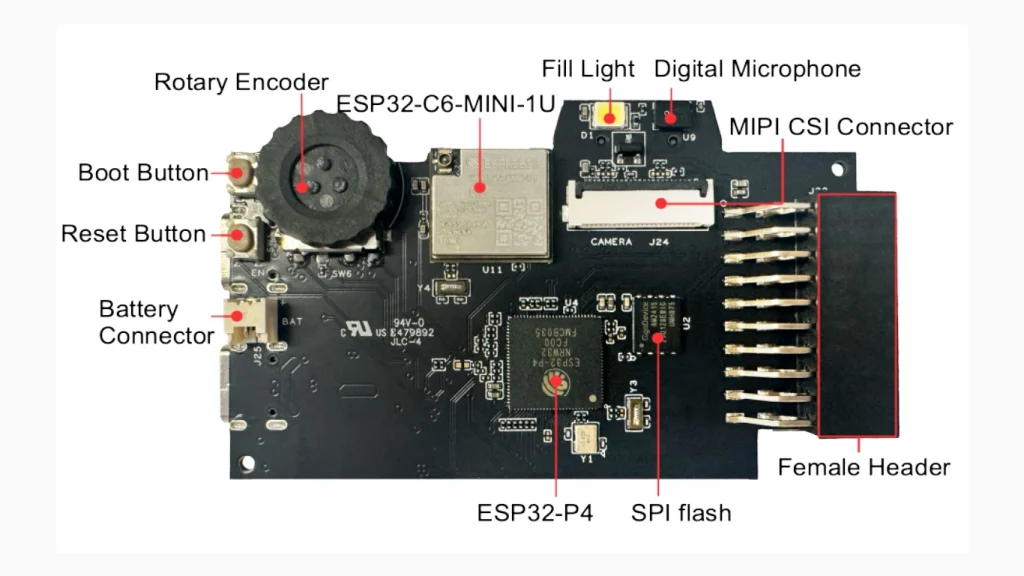
Beyond the main processor, the board integrates an ESP32-C6-MINI-1U module. This secondary module handles Wi-Fi and Bluetooth communication, offloading the networking stack from the primary P4 processor to ensure maximum performance for vision tasks. This dual-chip strategy allows for a low-power, high-efficiency network-connected ecosystem where image processing and wireless data transmission occur in parallel without contention.
2. Power Infrastructure and Management
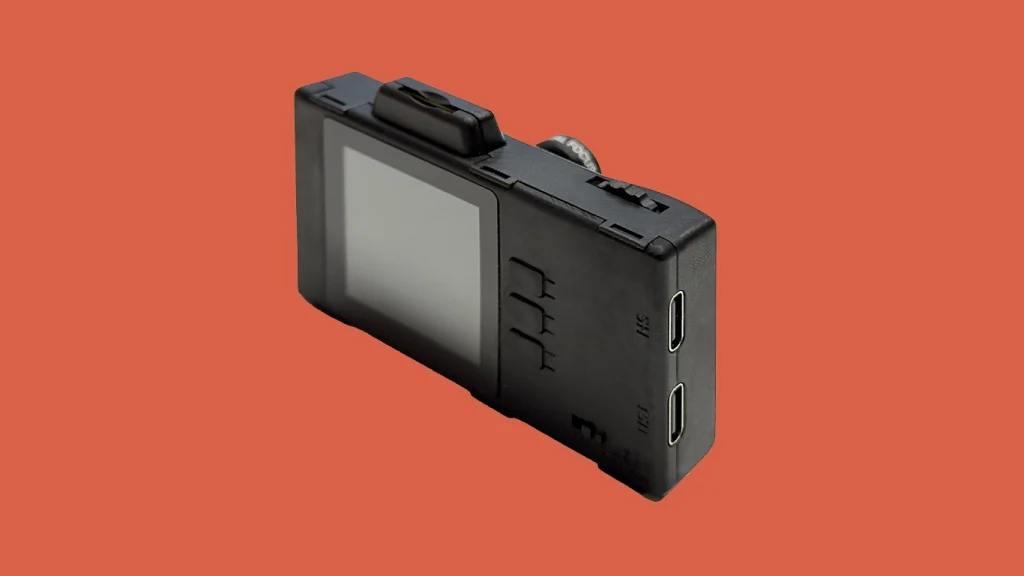
The power tree of the ESP32-P4X-EYE is designed for both stationary and portable operation. The board can be powered via the USB 2.0 High-Speed Device Port or the dedicated USB Debug Port. Internally, these 5V inputs are regulated to provide stable rails for the SoC and peripherals. For portable applications, a dedicated battery connector supports lithium-polymer cells. The board includes an integrated charging circuit that automatically manages battery levels when USB power is present.
WARNING: Do not use multiple power sources (e.g., USB-to-UART port and Battery) simultaneously unless you are certain of the power path isolation. Providing conflicting power sources can lead to permanent hardware damage, overheating of the LDO, or battery failure.
The Role of the LDO in Voltage Stability
A critical component in the ESP32-P4X-EYE Pinout ecosystem is the Low Dropout (LDO) regulator. In digital circuits, the transition between logical ‘high’ and ‘low’ states requires a clean, ripple-free voltage supply. The LDO acts as a linear regulator that stabilizes the incoming 5V USB power down to a precise 3.3V required by the ESP32-P4 and its peripherals. Unlike switching regulators, LDOs offer superior noise rejection, which is vital for analog-to-digital conversions and stable camera sensor operation. However, LDOs dissipate the voltage difference as heat; thus, thermal management through PCB copper pours and thermal vias is necessary to prevent thermal throttling during high-current operations.
3. Detailed ESP32-P4X-EYE Pinout Table
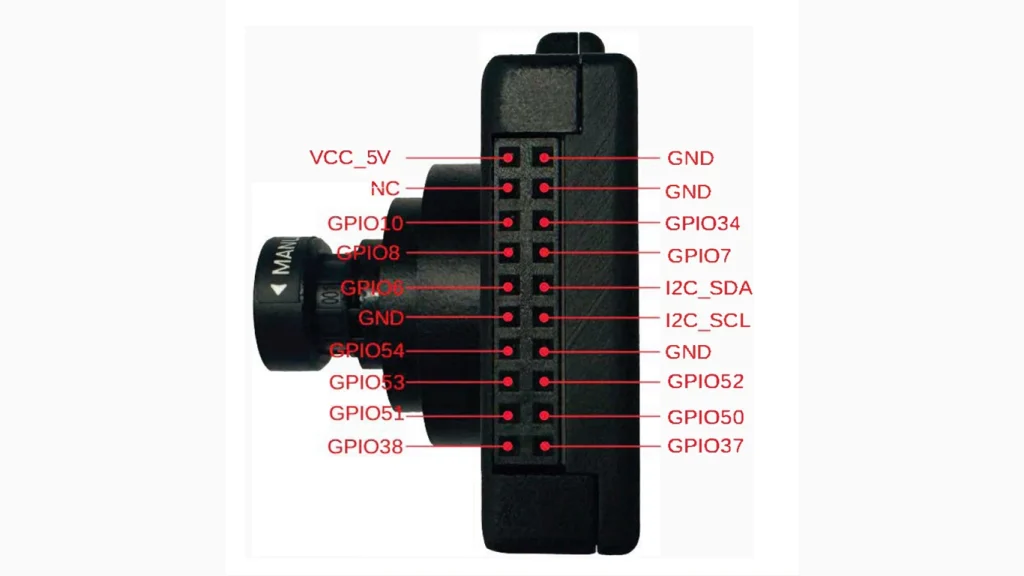
The following table details the female header interfaces (J5). Every pin is listed individually to ensure developers have a comprehensive map for hardware expansion. Reference this table when connecting external sensors or custom daughterboards.
| Pin # | Name | Type | Function |
|---|---|---|---|
| 1 | 5V | P | 5V Power Supply |
| 2 | GND | P | Ground |
| 3 | NC | — | No Connection |
| 4 | GND | P | Ground |
| 5 | GPIO10 | I/O | General Purpose I/O |
| 6 | GPIO34 | I/O | General Purpose I/O |
| 7 | GPIO8 | I/O | General Purpose I/O |
| 8 | GPIO7 | I/O | General Purpose I/O |
| 9 | GPIO9 | I/O | General Purpose I/O |
| 10 | GPIO25 | I/O | General Purpose I/O / I2C SDA |
| 11 | GND | P | Ground |
| 12 | GPIO24 | I/O | General Purpose I/O / I2C SCL |
| 13 | GPIO54 | I/O | General Purpose I/O |
| 14 | GND | P | Ground |
| 15 | GPIO53 | I/O | General Purpose I/O |
| 16 | GPIO52 | I/O | General Purpose I/O |
| 17 | GPIO51 | I/O | General Purpose I/O |
| 18 | GPIO50 | I/O | General Purpose I/O |
| 19 | GPIO38 | I/O | General Purpose I/O |
| 20 | GPIO37 | I/O | General Purpose I/O |
4. Advanced Communication Protocols
UART: The Bridge to Development
The Universal Asynchronous Receiver-Transmitter (UART) is the fundamental serial interface used for communication between the SoC and a computer. In the ESP32-P4X-EYE Pinout configuration, the UART interface is accessed via the USB-Serial-JTAG interface of the ESP32-P4
. This protocol relies on precise baud rate synchronization—the speed at which data bits are transmitted. Because UART is asynchronous, there is no shared clock signal; instead, the transmitter and receiver must be configured to the same frequency. Logic levels are typically 3.3V, meaning a logical ‘1’ corresponds to the rail voltage and ‘0’ to ground. This interface is the primary tool for flashing firmware and viewing real-time debug logs.
ADC: Digitizing the Analog World
The Analog-to-Digital Converter (ADC) allows the ESP32-P4 to interpret real-world signals, such as battery voltage or analog sensor data. The ESP32-P4 utilizes a Successive Approximation Register (SAR) architecture. This process involves a binary search through the voltage range to find the digital value that best represents the analog input. The resolution determines the granularity of this measurement, while the reference voltage (Vref) sets the maximum measurable input. When using the ESP32-P4X-EYE Pinout for ADC tasks, developers must account for non-linearity at the extremes of the voltage range to ensure accurate data processing.
5. Programming and Strapping Pins
To flash new firmware, the board must enter «Firmware Download Mode». This is governed by strapping pins, which are sampled by the hardware at the moment of boot or reset. These pins determine whether the SoC boots from internal Flash or waits for a serial download. On the ESP32-P4X-EYE, this is handled by the Boot and Reset buttons. By holding the Boot button and pressing the Reset button, the strapping logic pulls the necessary GPIOs to their required states, triggering the ROM bootloader to accept new code over the USB Debug Port.
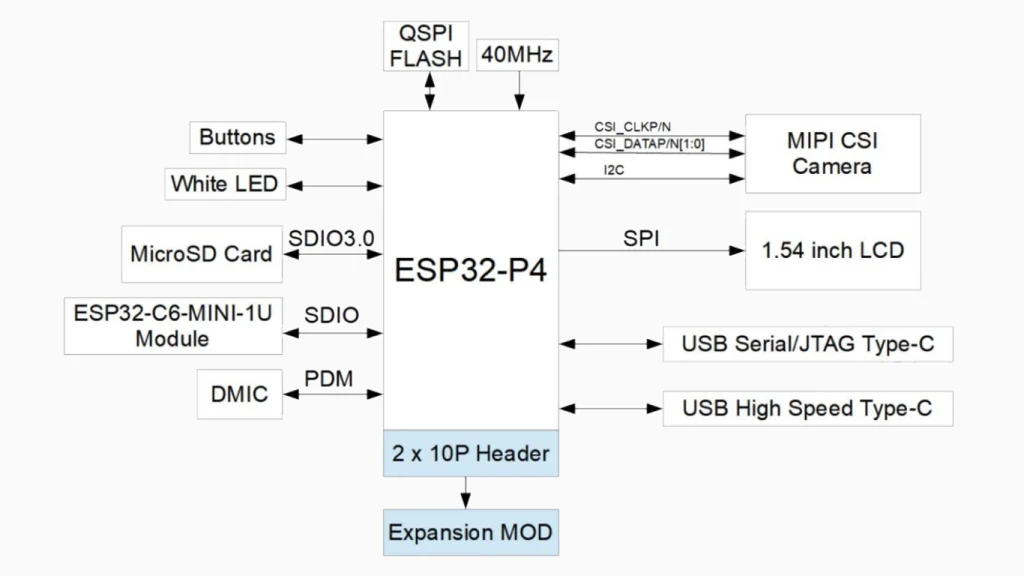
The block diagram highlights the intricate routing between the ESP32-P4 and its peripherals. High-speed signals like MIPI-CSI for the camera and SPI for the 1.54-inch LCD require careful layout to minimize electromagnetic interference. The ESP32-P4X-EYE Pinout is designed to keep these high-frequency paths short, ensuring that the 240×240 resolution display can provide a lag-free preview of the camera’s image stream.
6. Conclusion
The ESP32-P4X-EYE Pinout provides a gateway to a professional-grade vision development environment. By mastering the electrical characteristics of the LDO, the timing requirements of UART, and the sampling logic of the strapping pins, engineers can leverage the full power of the RISC-V dual-core architecture. Whether building a smart surveillance camera or an edge computing node, the ESP32-P4X-EYE stands as a versatile and powerful foundation for the next generation of IoT vision products.
7. References & Legal Notice
This technical manual is developed based on the official documentation provided by Espressif Systems. We highly recommend referring to the primary source for the most recent updates regarding hardware revisions and detailed specifications.
Disclaimer: ESP32 and ESP32-S2 are registered trademarks of Espressif Systems (Shanghai) Co., Ltd. This guide is an independent technical review and is not an official publication of Espressif Systems.